Saturn
From Halbeeg, the open encyclopedia · Af-Soomaali
240 languages
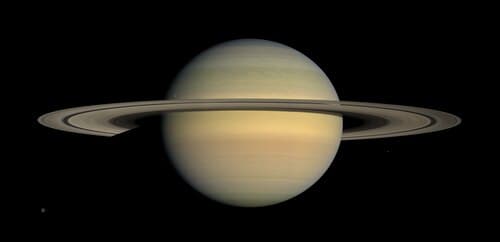
Saturn is the sixth planet from the Sun and the second largest in the solar system after Jupiter. It is a gas giant, meaning it has no solid surface to stand on and consists mainly of hydrogen and helium.
Saturn's most distinctive feature is its rings, composed of ice and rock particles in vast numbers orbiting the planet. These rings make it the easiest planet to identify when viewed through a telescope. Saturn also has many moons, the largest of which is Titan.
Physical characteristics
Saturn is a large planet with relatively low density relative to its size. It rotates rapidly around its axis, which causes it to bulge at the equator and flatten at the poles. Its atmosphere displays parallel bands and large storms that can last months or years.
The rings
The rings extend over vast distances but are very thin. Scientists have classified them into sections designated by letters (for example A, B, C), separated by clear gaps. The origin of the ring material is uncertain—it may be remnants of a destroyed moon or material that never formed into a planet.
The moons
Titan is Saturn's largest moon and has a thick atmosphere composed of nitrogen, and methane lakes and seas have been found on its surface. Enceladus is another moon known to eject water from beneath its icy crust, prompting scientists to investigate the possibility of a subsurface ocean.
Exploration
Several spacecraft have visited Saturn, most notably the Cassini mission, which orbited the planet for many years and transmitted images and extensive data. This exploration expanded knowledge of the atmosphere, rings, and moons.